News |
|
The term describes the generation of short electrical pulses that are associated with very high electrical power and therefore with high voltage and current amplitudes. For example a pulse with an amplitude of 100 kV (i.e. 100000 volts)
and a duration of 100 ns (i.e. 0.0000001 seconds) delivers to a load of 10 ohms a power of 1 GW (1 gigawatt or 1000000000 watts). This is equivalent to the output of a nuclear power plant, although for the mere
100 ns of operation that it is available, the energy that is provided wouldn't even be sufficient to heat up your cup of coffee by even 1 degree. As you can imagine these extreme conditions can not be realized readily
on a typical printed circuit board. Furthermore, even material properties will be different when voltages of that magnitude are applied. Consequently, there is a devoted scientific community researching these topics
and many different aspects and applications of Pulsed Power Science and Technology. If I have sparked your interest, I encourage you to follow some of the links provided here.
Welcome to pulsedpower.eu
On purpose or by accident, you have found what has become my research homepage. This page gives an introduction into the areas of Pulsed Power and Bioelectrics. There is a close relation between both fields. In particular, you will find how short electric pulses can be used in medical and environmental applications. Since this is the main topic of our research, you will find also updates on our work here - which is probably why you were looking for this page in the first place. If you just stumbled across this page, however, I still hope you spend a little time to let me convince you that this line of work is pretty 'cool stuff' allowing us to do some amazing things.
What can you do with Pulsed Power?
 |
|
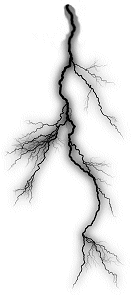
Pulsed power in nature: voltage differences of 10-100 MV between heaven and earth lead to a "spark" which lasts for about 100 µs and carries currents on the order of 30 kA (return stroke).
About 3.5 billion years ago, lightning in the early atmosphere is believed to have generated the first building blocks of life (amino acids).
|
Everbody's got an Opinion - Here's Mine: |
|
A growing interest in Pulsed Power technologies can also be found for medical and biological and environmental questions. Pulsed electrical discharges can be designed to create so-called 'streamers'. This non-thermal plasma has the ability to attack biological and chemical agents alike and is in particular promising for decontamination and purification of water (both fresh water and waste water). Another emerging application is the manipulation of mammalian cells with pulsed electric fields. 'Longer' pulses (in the microsecond range) are a widely successful tool to bring large molecules into cells as it is for example need in gene therapies. 'Shorter' pulses have demonstrated an ability to affect cells on a subcellular level. One of the most appealing results so far is that they can trigger apoptosis in cancer cells. By reminding cancer cells to undergo this 'programmed cell death', which these cells have forgotten, pulsed electric fields can be used to fight tumors. Both the use of discharge plasmas and pulsed electric fields on cells and tissues are cornerstones of a new era in biomedical engineering, summarized as Bioelectrics.
What is Bioelectrics?
 |
|
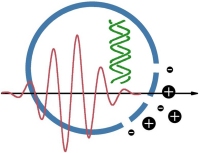
Logo of the Frank Reidy Research Center for Bioelectrics. It shows the interaction of electromagnetic radiation and ions generated from a plasma with a cell.
|
Who am I?
 |
|
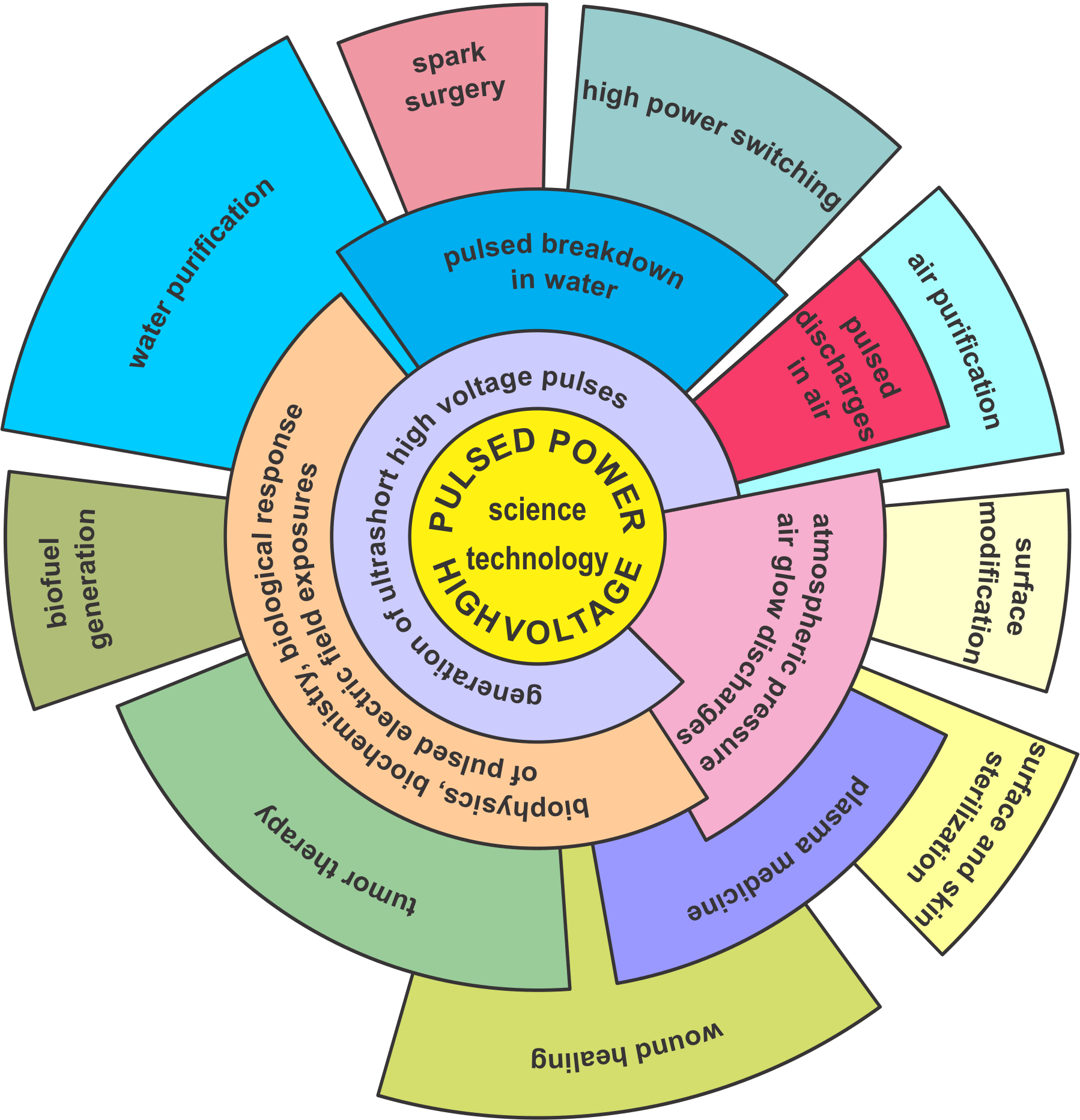
Overview of research topics and applications that are enabled by Pulsed Power and High Voltage Science and Technologies and are pursued in our research. |
I am hosting this webpage as my research homepage. You will therefore find mostly discussions and presentations on my own reasearch projects here. An overview of all the different ideas that we have been or are are currently pursuing is shown in the figure on the right. I hope it conveys the strong interconnection of different research aspects and how ever more applications sprout from the possibilities that Pulsed Power and High Voltage Engineering offer. At the same time, we address ever new interesting questions in physics, chemistry and biology that are increasing our knowledge of how nature works ever further.
Unfortunately time constraints will probably force me to keep this page more 'static' than I would like it to be. As you might have figured out by now, my main research interest lies in medical and environmental applications of pulsed electric fields and non-thermal plasmas. Apart from that - and closely related - is a keen interest of mine in Pulsed Power Science and Technologies. For this reason I will also use this webpage as a forum for other Pulsed Power topics that interest me. Last but not least I will use this page as 'resource page' both for my class on pulsed power and to provide tools, links etc. of general interest. I hope you will find this page useful and enjoy it. For the future I'm planing to put up also a similar websites on Bioelectrics. That both websites are registered as European (.eu) and German (.de) domains simply lies in the fact that the US domains were already taken.
Juergen Kolb, January 2009 (last update: September 2011)
mail to: webmaster@pulsedpower.de